
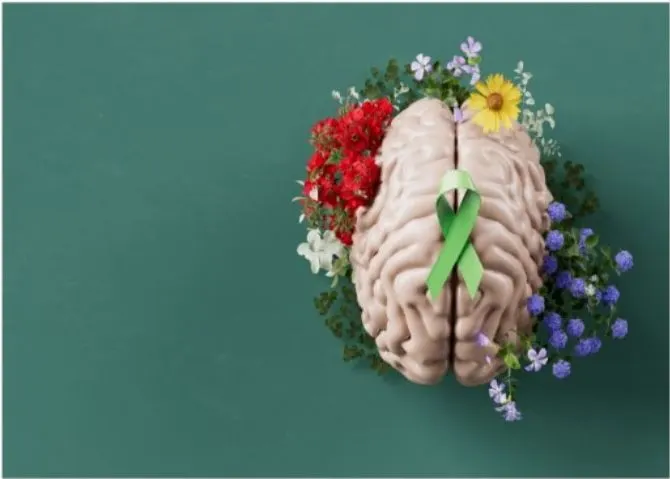
We've come a long way.
Mental health is no longer the whispered topic it once was. Therapy is talked about openly. Public figures share their struggles. Workplaces offer wellness days. Awareness ribbons show up across our feeds every May.
So it would be easy to assume stigma is fading. Maybe even gone.
But the research tells a different story. Stigma remains a persistent and well-documented barrier to mental health recovery, with studies showing it continues to affect the majority of people living with mental health conditions across nearly every region of the world (Corrigan et al., 2014; Thornicroft et al., 2022). In fact, many people describe stigma as being worse than the condition itself (Thornicroft et al., 2022).
Stigma hasn't disappeared. It's just gotten quieter. And often, it's moved somewhere we don't expect. It's moved inward.
What Is Self-Stigma?
Self-stigma occurs when individuals internalize negative public attitudes about mental illness and begin to apply those beliefs to themselves, resulting in diminished self-esteem, reduced self-efficacy, and a sense of being "less than" (Corrigan et al., 2014; Livingston & Boyd, 2010). The messages once delivered by the outside world begin playing on a loop on the inside — until they no longer sound like the world's voice. They sound like ours.
Self-stigma whispers things like:
- "I should be able to handle this on my own."
- "If people knew, they'd see me differently."
- "I'm too much."
- "Something is wrong with me."
- "I'll always be like this."
Research consistently shows that self-stigma is associated with reduced help-seeking behavior, lower treatment engagement, social withdrawal, hopelessness, and poorer recovery outcomes (Clement et al., 2015; Livingston & Boyd, 2010). It is one of the most powerful — and quietest — reasons individuals delay reaching out for support for months or even years.
Self-stigma doesn't always look like shame. Sometimes it looks like perfectionism. Overworking. People-pleasing. Isolation. Numbing. Staying busy enough to outrun the feelings.
Why It's So Hard to Spot
Public stigma is loud. It looks like discrimination, stereotypes, hurtful comments, or being treated differently. We can name it, push back against it, and advocate against it.
Self-stigma is harder because it sounds like you. It uses your voice, your memories, your fears. Corrigan and colleagues (2016) describe this as the "why try" effect — a phenomenon in which internalized stigma erodes a person's belief that recovery, connection, or a meaningful life is even possible for them. The thinking shifts from "I have a condition" to "Why even try? I'm not worth it."
And that's the wound. Not the struggle itself, but the belief that the struggle defines who you are.
The Way Forward
Healing from self-stigma doesn't happen in a single moment. It happens in small, brave choices, repeated often. Evidence-based approaches — including cognitive restructuring, narrative therapy, peer support, psychoeducation, and self-compassion practices — have been shown to reduce internalized stigma and improve well-being (Alonso et al., 2019; Neff, 2023; Yanos et al., 2015).
Practical steps include:
- Speaking to yourself with the same kindness you'd offer a friend.
- Letting people in, even when it feels safer to stay hidden.
- Reframing the inner voice from "I am the problem" to "I'm navigating something hard."
- Choosing language rooted in dignity instead of diagnosis.
- Believing — even on the days it feels untrue — that you are worthy of care, exactly as you are.
You are not your hardest season. You are not the thoughts that try to shrink you. You are a whole person — still growing, still becoming, still worthy of love and support.
This Mental Health Awareness Month, the most radical thing you can do may be to question the quiet voice inside that's been carrying stigma for you all along.
You can set it down. You were never meant to carry it.
References
Alonso, M., Guillén, A. I., & Muñoz, M. (2019). Interventions to reduce internalized stigma in individuals with mental illness: A systematic review. The Spanish Journal of Psychology, 22, E27.
Clement, S., Schauman, O., Graham, T., Maggioni, F., Evans-Lacko, S., Bezborodovs, N., Morgan, C., Rüsch, N., Brown, J. S. L., & Thornicroft, G. (2015). What is the impact of mental health-related stigma on help-seeking? A systematic review of quantitative and qualitative studies. Psychological Medicine, 45(1), 11–27.
Corrigan, P. W., Bink, A. B., Schmidt, A., Jones, N., & Rüsch, N. (2016). What is the impact of self-stigma? Loss of self-respect and the "why try" effect. Journal of Mental Health, 25(1), 10–15.
Corrigan, P. W., Druss, B. G., & Perlick, D. A. (2014). The impact of mental illness stigma on seeking and participating in mental health care. Psychological Science in the Public Interest, 15(2), 37–70.
Livingston, J. D., & Boyd, J. E. (2010). Correlates and consequences of internalized stigma for people living with mental illness: A systematic review and meta-analysis. Social Science & Medicine, 71(12), 2150–2161.
Neff, K. D. (2023). Self-compassion: Theory, method, research, and intervention. Annual Review of Psychology, 74, 193–218.
Thornicroft, G., Sunkel, C., Alikhon Aliev, A., et al. (2022). The Lancet Commission on ending stigma and discrimination in mental health. The Lancet, 400(10361), 1438–1480.
Yanos, P. T., Lucksted, A., Drapalski, A. L., Roe, D., & Lysaker, P. (2015). Interventions targeting mental health self-stigma: A review and comparison. Psychiatric Rehabilitation Journal, 38(2), 171–178.