

Last week, we talked about the silent signals of depression — the changes that often go unnoticed in the people we love. But noticing is only the first step. The harder question is what comes next: “What do I actually say?”
If that question stops you from reaching out, you are far from alone. Most of us have never been taught how to have this conversation. We worry we’ll say the wrong thing. We worry we’ll make it worse. We worry we’ll ask about suicide and somehow plant the idea.
Asking about suicide does not plant the idea
This is one of the most persistent and dangerous myths in mental health, and the evidence against it is clear. A landmark 2014 review by Dazzi and colleagues examined 13 studies of both adolescents and adults. None found a statistically significant increase in suicidal ideation as a result of being asked about suicide. Some studies found the opposite — asking reduced distress and gave people permission to name what they had been carrying alone (Dazzi et al., 2014). A more recent meta-analysis reached the same conclusion (DeCou & Schumann, 2018).
Five steps for having the conversation
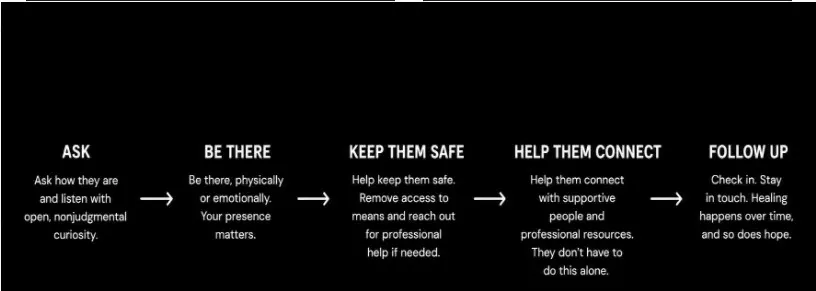
The following framework is adapted from the evidence-based #BeThe1To campaign supported by the 988 Suicide & Crisis Lifeline and the National Action Alliance for Suicide Prevention (2024).
1. Ask. Ask the question directly. Use the word. “Are you thinking about suicide?” Vague questions like “You’re not thinking about doing anything, are you?” make it harder for someone to tell the truth. Direct, calm, and caring is what works.
2. Be there. Listen without judgment. Let them finish sentences. Don’t rush to solutions. Sometimes the most healing sentence is: “I hear you. I’m not going anywhere.”
3. Keep them safe. If they share thoughts of suicide, gently ask about specifics. Do they have a plan? Do they have access to means? Reducing access to lethal means during a crisis is one of the most effective ways to prevent suicide. This is not about interrogation. It is about care.
4. Help them connect. Connect them to ongoing support — a therapist, psychiatric provider, primary care doctor, 988 Lifeline, or Crisis Text Line. Offer to help them make the call. Don’t just hand them a phone number and hope.
5. Follow up. Check back in — the next day, the next week, and the week after that. Research shows follow-up contact after a crisis, even a short call or text, significantly reduces the risk of future attempts.
Language that helps
- “I’ve noticed you seem different lately. I’m worried about you.”
- “Are you thinking about suicide?”
- “I care about you. I’m here.”
- “You don’t have to figure this out alone.”
- “Can I sit with you while you make the call?”
- “How are you doing today?” (asked again next week, and the week after)
Language that hurts
- “You have so much to live for.” (Can feel dismissive of real pain.)
- “Think of what this would do to your family.” (Adds guilt, which increases isolation.)
- “Other people have it worse.” (Pain isn’t a competition.)
- “You shouldn’t feel that way.” (Feelings don’t respond to “shouldn’t.”)
- “I know exactly how you feel.” (You may not — and it can shut down the conversation.)
What to do if you’re worried right now
If someone you love is in immediate danger — with a plan and the means, or has already begun to act — this is an emergency.
- Stay with them. Do not leave them alone.
- Call or text 988 together, or call 911.
- If safe to do so, help remove access to firearms, medications, or other lethal means.
- Take them to the nearest emergency room, or wait with them for help to arrive.
If the situation is serious but not immediate, help them make an appointment with a psychiatric provider or therapist within days, not weeks.
A word to the person who is struggling
If you are reading this and the person you’re worried about is you — please hear this clearly: your life matters. What you are feeling is real, and it is treatable. Suicidal thoughts are not who you are. They are a symptom — often of untreated depression, trauma, or chronic stress — and one of the most treatable conditions in modern medicine.
You do not need to be in a crisis to reach out. You do not need to have the words. You just need to make one call. Call or text 988 right now, or call our office to schedule a confidential appointment.
You are not a burden. You are a person the world would miss.

We are here when you’re ready
Whether you’re the person worried about a loved one, or you’re the one carrying more than anyone knows — we are here. Our team offers psychiatric evaluation, therapy, and medication management with no shame and no judgment.
Tampa: 813-252-0171 | Lakeland: 863-250-0240
In crisis right now? Call or text 988, or 911 for emergencies.
References
Dazzi, T., Gribble, R., Wessely, S., & Fear, N. T. (2014). Psychological Medicine, 44(16), 3361–3363.
DeCou, C. R., & Schumann, M. E. (2018). On the iatrogenic risk of assessing suicidality: A meta-analysis. Suicide and Life-Threatening Behavior, 48(5), 531–543.
National Action Alliance for Suicide Prevention. (2024). #BeThe1To: 5 action steps for helping someone in emotional pain.